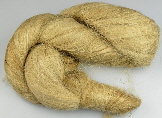
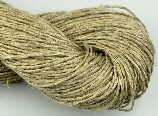
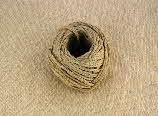
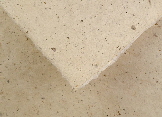
Nettle fibres from European nettle, Ramie and Himalayan nettle
Several species of the nettle family (Urticaceae) produce bast fibres similar to flax, and many of those species have been used to produce fibre for making textiles and clothing for thousands of years. The three main fibre producing species are European nettle, Ramie and Himalayan nettle. European nettle is difficult to grow commercially. Ramie, on the other hand, produces a fine fibre that is produced commercially in China and Japan. Himalayan nettle is a large nettle grown mainly in the Himalayan region. In all these species, the fibre comes from the stem and, incidentally, there is no sting left in the extracted fibre.
1) European nettle
2) Himalayan Nettle or Allo
3) Ramie (opens new page)
4) Hemp (this page)
1) European Nettle or Stinging Nettle
The common Stinging Nettle, Urtica dioica, is a widely distributed plant that grows very easily on damp disturbed ground. It has been used as fodder for livestock and to make tea, beer, rennet and a plant dye.
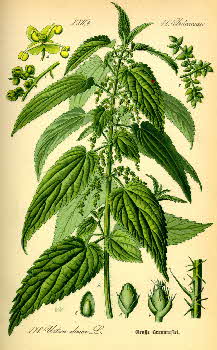
It is related to flax and hemp and can be used to produce a fine linen cloth. The first known nettle textile find in Europe is from the late Bronze Age in Voldtofte in Denmark (Barber) and there is evidence of nettle cloth production from Scandinavia, Poland, Germany and Russia. It does not appear to have been as widely used for fibre and textile production as flax and hemp, except in northern, central and eastern Europe.
In Poland, nettle thread was used until the 17th century, when it was replaced by silk, and nettle cloth continued to be produced in Scandinavia, and in also Scotland until the 19th century where it was known as Scotch cloth. In the first World War, the shortage of cotton resulted in the Germans cultivating nettles to make clothing.
The Voldtofte textiles had been assumed to be pure flax, as had the Oseberg Ship textiles, until they were examined by a nettle expert and shown to be made from nettle fibre not flax (Barber).
Nettle fibres are white, silky, up to 50mm (2”) long, and produce a finer and silkier fabric than flax, so that it is possible that fine linens for the wealthy may have been woven from nettle rather than flax.
Top of page
3) Himalayan Nettle or Allo (Girardinia diversifolia)
Although called Himalayan nettle, this plant grows wild in Africa and several Asian countries. In Nepal, Himalayan nettle grows wild in fertile forest soils in altitudes ranging from 1200 to 3000 metres. It can be an annual or a short lived perennial plant up to 1.5 metres in height. All parts of the plants are covered in thorn-like stinging hairs that can cause painful rashes.
Himalayan nettle plants have been uses for centuries as a fibre source. The fibre comes from the stem, and it is very long and strong, similar to ramie. After cutting the stem, the bark is removed and peeled and fibre is extracted.
It has traditionally been made into cordage for string, ropes and fishing nets, but it is also spun into yarns and used to weave durable jackets, mats, bags and blankets. Himalayan nettle fibre can be blended with ramie, cotton and wool.
NGOs have conducted income generating programmes, with training on better ways of processing, spinning and weaving Himalayan nettle. As a result, Himalayan nettle yarn and handicrafts are available for sale in the UK. Almost all items sold in the UK as being made from ‘nettle’ come from Himalayan nettle plants.
|