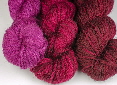
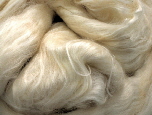
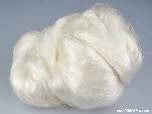
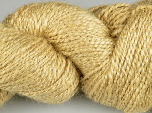
Silk is a very special natural fibre. It is lustrous, and smooth, drapes well and is very strong. Silk takes dyes very well and can be made in brilliant colours. Silk is important historically and has been in use for at least 5,500 years.
Most commercial silk is mulberry silk, which is also known as cultivated silk or bombyx silk. Mulberry silk is white, 10 to 14 microns in diameter and round in cross-section. This type of silk is produced from cocoons of the mulberry silkworm (Bombyx mori), a caterpillar that eats mulberry leaves.
Wool and silk differ in both origin and structure. Wool and hair are formed of the protein ‘keratin’ and grow either continuously or seasonally from the outer skin layer or dermis of mammals, such as sheep and goats. Silk is ‘fibroin’, a protein that is produced on demand from special silk glands of several groups of invertebrate animals, including silk moths, and is extruded as a liquid through openings called spinnerets in a process similar to the production of rayon. Spiders use this silk to spin a spider’s web, and silkworms spin a protective cocoon for the vulnerable pupa stage.
Silk is produced by many insects and by spiders but most commercial silk comes from the caterpillars (larvae or silkworms) of silk moths of the superfamily Bombycoidea. Several different groups of silk moths are used to produce wild silk but cultivated silk from larvae of the Mulberry Silkworm moth, Bombyx mori, accounts for most commercial production. Bombyx mori appears to be descended from the wild silk moth Bombyx mandarina which is very widely distributed in China and Japan, also feeds on mulberry (of which it is considered a pest) and which crosses readily with Bombyx mori (Aruga, 1994).
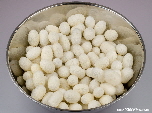
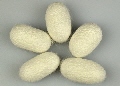
The female silk moth is short-lived and produces about 500 eggs in 4-5 days before dying. Like almost all members of this group, it has no proboscis and does not feed. The larva, however, feeds voraciously on mulberry leaves, before reaching full size in about 35 days in optimum conditions of temperature and food quality. It then spins a silk cocoon so that it is protected whilst changing into the immobile pupa stage and then develops into an adult moth inside the pupa.
The silk is produced as a thick sticky liquid through the openings of two spinnerets under the mouth and solidifies in the air to form twin filaments of silk that become glued together into a single thread with sericin. Up to 1,300 metres of this silk fibre may be produced in a three day period.