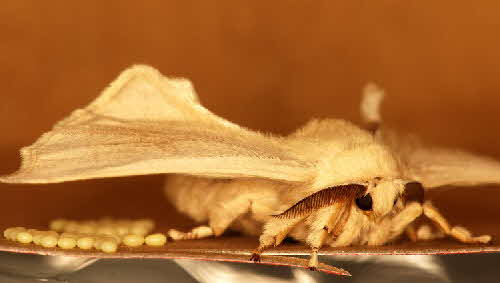
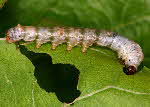
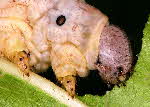
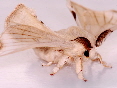
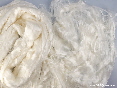
Silkworms are special as they are the only truly domesticated insect. Most commercial silk is Mulberry silk that is produced from cocoons of the Mulberry silkmoth, Bombyx mori, and comes mainly from China and India. The rearing of silk worms and reeling of silk is called sericulture.
Silkworm moths go through four stages of development – egg, larva, pupa and adult – as do the majority of insects. Butterflies and moths, two-winged flies, bees and wasps, and beetles all have this 4-stage life cycle. Mulberry Silkworms are the caterpillars or larvae of Mulberry silkworm moths and feed on the leaves of mulberry trees (Morus spp).
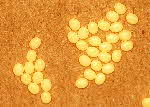
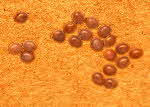
The female moths lay 200-500 pale-yellow eggs over a couple of days and usually die within 2 weeks. Fertile eggs then turn to brownish in a week or so.
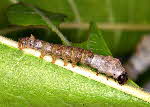
The eggs hatch in 10-14 days to produce a very small blackish first instar larva, less than 2mm or ⅛ inch in length. At ideal temperatures (25° to 30°C), the larva grows to 3 inches (75mm) in length in 25-30 days and Rennie and Westwood calculate that it increases 9,000 times in weight during that time. To accommodate this enormous increase in size, it sheds its skin four times and therefore goes through 5 larval stages or instars before it is ready to pupate.
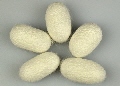
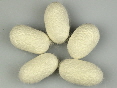
When the silkworm larva is fully grown and ready to pupate, it stops feeding, looks for suitable location and starts to spin a hammock of silk in which to form the cocoon.