|
1. Iron Age & Dark Ages
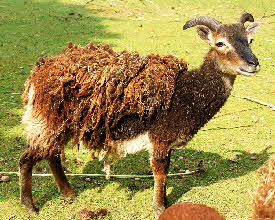 Domestication of wild sheep took place by 7000 BC in central Asia (Barber) and, possibly, considerably before. Ryder, who has written extensively on the history of sheep in Britain, suggests that the first domestic sheep were introduced into Britain by Neolithic settlers around 4000 BC and that these were probably horned brown sheep, similar to Soay. Preserved wool from the Bronze Age appears to be Soay. Domestication of wild sheep took place by 7000 BC in central Asia (Barber) and, possibly, considerably before. Ryder, who has written extensively on the history of sheep in Britain, suggests that the first domestic sheep were introduced into Britain by Neolithic settlers around 4000 BC and that these were probably horned brown sheep, similar to Soay. Preserved wool from the Bronze Age appears to be Soay.
Soay are unusual in having an annual moult, in contrast to modern sheep where the wool grows continuously. Soay wool is traditionally collected by combing or plucking not shearing.
Ryder suggests that four main groups of wool-bearing sheep in Britain have developed from the original Soay and from a number of subsequent introductions. These four groups are,
- white-faced short-wools,
- white-faced horned
- long-wools, and
- black-faced horned.
To these, we may add semi-lustre and lustre long-wools as more modern groups that have been bred from the original types.
The Romans introduced hornless, white-faced short-wool sheep that may have crossed with indigenous Soay to produce the tan or white-faced horned sheep that are currently found in Scotland and Wales. The Roman sheep probably gave rise to medieval short-wools, such as Ryeland, and later to medieval long-wools similar to Romney.
Later, the Danes introduced black-faced horned, short-wool sheep into the north and east of England (the original Danelaw) that produced modern Downs breeds and black-faced breeds such as the Pennines and the Scottish Blackface.
Top of page
2. Medieval Sheep and Wool
Although most commercial production of wool now comes from descendants of Spanish merino sheep, England produced Europe's finest wools during the Middle Ages. Spanish wools were amongst the worst in Europe and were used in the production of the very cheapest fabrics
(see Munro).
Eileen Power states that there were two principal types of medieval sheep in England, a small sheep producing short wool and a larger sheep producing long wool. The short-woolled sheep was a native of poor pastures, hills, moors and downs and produced wool prepared by carding that was used to make cloth (that is textiles of heavy texture thickened by fulling). The long-woolled sheep was found in rich grasslands, marshes and fens and produced wool, prepared by combing and used for lighter worsteds and serges (materials which were not usually fulled).
Power notes three breeds as accounting for most wool production in the Middle Ages, Ryeland, Cotswold and Lincoln. Ryeland was the most famous of short-woolled breeds, grown in the country between the Severn and the marches of Wales, and was largely responsible for the ‘Lemster ore’, the golden fleece of England. The bulk of the fine wool exported in the Middle Ages came from two long-woolled breeds, however, Cotswold and Lincoln and in the fifteenth century the largest source of fine wool seems to have been the Cotswolds.
By the mid-fifteenth century, merino wool had started to improve in quality and to compete with mid-range English wools. Long periods of wars affecting wool supply and then serious mistakes in English wool taxation in the 1390s and in the period 1429 to 1473 finally resulted in European textile producers, including the Flemish, deciding to switch to Spanish merino wool (Munro), although it was often mixed with English wools to improve the quality.
- Wool from sheep
- Fibre sizes and choosing fibre
- Sheep breeds
- Historical context to the development of sheep breeds
- Fibre from other animals - alpaca, goats, rabbits, yak
Top of Page
|